Last updated June 28, 2026
Garage Door Warning Signs: A Miami Homeowner’s Reference Guide
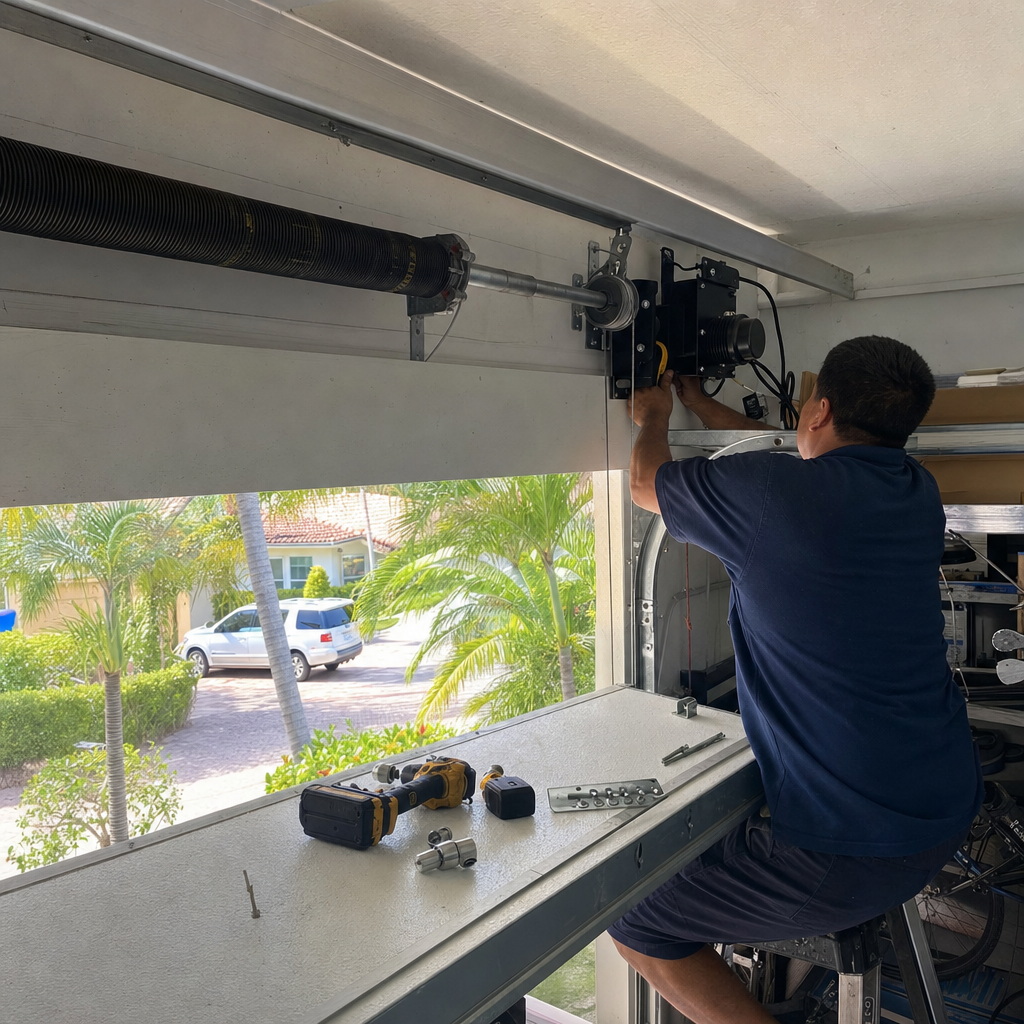
A garage door spring doesn’t snap without warning — it telegraphs the failure for weeks through sounds and movement patterns that most homeowners have learned to tune out. Here in Miami, that timeline is compressed. The combination of year-round humidity, salt air from Biscayne Bay, and summer heat that regularly pushes 95°F accelerates metal fatigue, seal degradation, and opener motor stress faster than nearly any other climate in the country. This guide is built around the early, easy-to-ignore signs that show up weeks before a failure — the ones that separate a $150 repair from a $900 emergency call at 10 p.m. on a Sunday.
Quick Answer
The most important garage door warning signs for Miami homeowners are sounds that change over time (scraping, grinding, or straining), visible rust streaking on springs or tracks, uneven door movement, and opener behavior that becomes sluggish or erratic in hot weather. Catching any one of these early — before a cable snaps or a spring breaks — typically turns a major repair into a straightforward service call.
Table of Contents
- The Sounds Your Door Makes — and What Each One Means
- Rust Bleed on Springs: The Orange Streak You Shouldn’t Ignore
- Why an Uneven Door Is Almost Never a Track Problem First
- Opener Behavior Changes That Signal Motor Stress
- Bottom Seal and Weatherstripping Degradation
- How to Spot Cable Wear Before a Cable Snaps
- Common Mistakes to Avoid
- When to Call a Professional
- Frequently Asked Questions
- The Bottom Line
The Sounds Your Door Makes — and What Each One Means
Sound is the first language a garage door uses when something is wrong. The problem is that the changes are gradual — a door that sounded perfectly quiet two years ago now makes a low grinding noise that you’ve simply stopped noticing. In our experience working on doors across Miami, Coral Gables, Kendall, and Doral, the homeowners who call us before a catastrophic failure are almost always the ones who paid attention to sound first.
Here’s how to tell the three most common problem sounds apart:
- Scraping that pulses rhythmically — If the scraping happens at regular intervals as the door travels, it’s almost always a roller. Specifically, a roller that has lost its nylon coating and is now metal-on-metal inside the track. This is a $80–$150 fix if you catch it early. Ignore it and the roller fragments into the track, bending it.
- Deep grinding that stays constant throughout travel — This is the sound of cable friction, usually a cable that’s fraying or has jumped its drum. Unlike roller scraping, cable grinding doesn’t pulse — it’s a steady rasp. Don’t run the door more than necessary once you hear this.
- Sharp metallic popping or cracking at the top of travel — This almost always originates from the spring system. In Miami’s heat, torsion spring coils expand and contract significantly between a 7 a.m. opening and a 3 p.m. opening. That thermal cycling causes stress fractures in spring coil ends, which you’ll hear as a sharp pop before you ever see a broken spring.
- Squealing that only happens at startup — Usually a worn bearing plate on the torsion bar, or dry rollers. Bearings on systems like older LiftMaster or Chamberlain openers see significant wear in humid environments; salt air acts like mild sandpaper on unsealed metal surfaces.
The key diagnostic principle: if a sound is new, it’s telling you something. A door that ran quietly for five years and now makes any noise at all has developed a mechanical change — and mechanical changes in Miami’s climate don’t resolve on their own.
Rust Bleed on Springs: The Orange Streak You Shouldn’t Ignore
One of the most reliable early warning signs we see in Miami garages — and one that almost every competitor’s article skips entirely — is rust bleed on torsion springs. You’ll recognize it as orange or rust-colored streaking that appears on the garage floor directly below the spring bar, or sometimes on the upper section of the door itself if the door is closing and vibrating rust particles loose.
Here’s why this matters so much in South Florida: Miami’s average relative humidity sits above 70% for most of the year, and garages in neighborhoods like Hialeah, Homestead, and Miami Beach see salt-laden air infiltration that accelerates oxidation on uncoated steel springs by two to three times compared to inland markets. A spring that might last 10,000 cycles in Denver may show significant corrosion at 6,000 cycles here.
What rust bleed tells you specifically:
- Surface rust (light orange dusting) — The spring coating has failed but the steel hasn’t pitted yet. Lubrication with a penetrating oil and monitoring is appropriate here. Replacement isn’t urgent but should be scheduled within the next few months.
- Heavy rust streaking on the floor — The spring is actively shedding oxidized material, which means pitting is occurring. This is a spring that is structurally compromised. It’s still working, but the margin before failure is thin. Replacement should happen now, not “soon.”
- Rust staining on the top door panel — The spring is vibrating rust particles onto the door during operation. At this stage, the spring coil has significant corrosion between the coils. This is the stage closest to a snap failure.
A snapped torsion spring is dangerous. The coil releases stored tension rapidly and the cable system loses its counterbalance instantly. For a 16-foot door running on a Wayne Dalton or Clopay system, that stored tension is substantial. Don’t test this scenario — the rust streak on your floor is the warning the spring gives you before it gives out entirely.
Why an Uneven Door Is Almost Never a Track Problem First
When a garage door closes crooked — one side lower than the other, a visible gap at one corner, or a door that “leans” as it travels — most homeowners assume the tracks are bent or misaligned. In our experience across hundreds of South Florida service calls, that’s rarely where the problem starts.
The real cause of uneven door movement in Miami homes almost always traces back to one of these three sources:
- A broken or weakened spring on one side. Torsion spring systems use a single spring or a pair of springs to balance the door’s weight equally across both sides. When one spring loses tension — either through a partial break or fatigue — that side carries more of the door’s weight and drops lower during travel. The tracks look misaligned because the door is riding unevenly, but the tracks themselves are fine.
- A worn or frayed cable on one side. Extension spring systems use cables to transfer spring tension to the door. When one cable stretches more than the other — which happens unevenly in humid environments as cable strands corrode at different rates — one side of the door will travel faster than the other, producing the same uneven appearance.
- Hinge failure on a specific door section. In Miami garages, particularly in neighborhoods with older housing stock like Little Havana and Overtown, we frequently see bottom-bracket hinges that have cracked or pulled loose from the door panel. This causes one corner of the door to sag independent of any spring or cable issue.
The track is typically a secondary victim, not the primary cause. Once a door runs uneven for weeks or months, it begins abrading the track on one side, which then does create a track problem — but fixing only the track at that point doesn’t address the underlying cause. The door will be uneven again within weeks.
If your door is closing unevenly, run a visual check: look at both springs and both cables for visible asymmetry, rust, or fraying before assuming the tracks need adjustment.
Opener Behavior Changes That Signal Motor Stress
Miami’s heat is genuinely hard on garage door opener motors. When your garage regularly hits 100–110°F in the afternoon — which is common in south-facing garages in neighborhoods like Doral, Kendall, and Sweetwater from June through September — the motor’s thermal protection system activates more frequently. Over time, this cycle of thermal stress degrades the motor windings and the drive mechanism.
The behavior changes to watch for, in order of urgency:
- Slower response at the start of a cycle. If your LiftMaster, Genie, or Craftsman opener used to begin moving the door within a half-second of pressing the button and now takes one to two full seconds before engaging, the motor capacitor is weakening. This is often a $60–$90 capacitor replacement — but only if you catch it before the capacitor fails completely and the motor tries to start without it.
- A straining or laboring sound during travel. This sounds like the motor is working harder than it should — a lower-pitched, stressed hum rather than the normal operational sound. In most cases, this means the door’s mechanical resistance has increased (from dry rollers, spring fatigue, or a bent track) and the opener is compensating. The opener isn’t the root problem here, but it will become one if the resistance continues.
- Reversing mid-travel without obstruction. Modern openers like Chamberlain and LiftMaster use force-sensing and safety-reversing logic. When a motor is heat-stressed, it occasionally triggers a false reversal because the force sensor reads the laboring motor as an obstruction. This is the opener telling you it’s working too hard.
- The opener running but the door not moving. In belt-drive and chain-drive systems, the drive component can strip or slip when the motor is straining under excessive mechanical resistance. At this point, you’ve moved from a maintenance scenario into a repair scenario.
If your opener is showing any of these signs, the diagnostic priority is: check the door’s manual operation first. Disconnect the opener and try lifting the door by hand. It should lift smoothly and stay balanced at mid-travel. If it doesn’t, the door — not the opener — is the problem source.
Bottom Seal and Weatherstripping Degradation
Miami homeowners tend to underestimate what a failed bottom seal costs them. It’s not just water intrusion during tropical storms — though that alone can cause significant floor damage and mold growth in a humid climate where surfaces stay wet for days. A degraded bottom seal is also a direct pest entry point, and in South Florida, that means palmetto bugs, ants, and occasionally roof rats finding a clear path into your garage and from there into your home.
Here’s a five-step check you can do in under three minutes:
- Close the door fully and stand inside the garage. Look at the bottom edge of the door where it meets the floor. You should see the rubber seal compressing evenly across the entire width.
- Check for daylight gaps. Any gap where you can see light from outside is a gap large enough for water, insects, and small animals.
- Feel the seal material. Good rubber bottom seals are pliable. If the seal is brittle, cracked, or breaks when you flex it, it’s done — UV exposure and Miami’s heat cycle it out faster than in northern climates.
- Inspect the door’s side and top weatherstripping. Run your hand along the rubber side seals (astragal). Tears, gaps, or sections that have pulled away from the door stop allow wind-driven rain to enter — a genuine concern when tropical storms move through.
- Check the floor under the door after rain. Even a small amount of moisture on the garage floor directly below the door line after a storm indicates the seal isn’t doing its job.
Bottom seal replacement on a standard single or double door in Miami typically runs $80–$150 depending on door width and seal type. That’s a fraction of what water remediation or pest control costs after the seal has been failing silently for six months.
How to Spot Cable Wear Before a Cable Snaps
Garage door cables are the unsung component of the system — they do the physical work of transferring spring tension to the door panels, and they fail without dramatic warning sounds. Unlike springs, which often announce their weakness through popping or straining sounds, cables can look functional right up until a strand breaks. Here’s what to look for:
- Fraying or “broom-end” appearance on the cable. If the lower end of the cable — where it attaches to the bottom bracket — looks like a fraying rope or has visible broken strands splaying outward, that cable’s structural integrity is already compromised. Don’t wait.
- Rust streaking along the cable length. In Miami’s humidity, cables corrode from the inside out. If you see rust discoloration along the cable body, the individual steel strands inside are oxidizing and weakening.
- Cable slack on one side when the door is closed. A properly tensioned cable should be taut with minimal slack when the door is in the closed position. Visible looping or sagging on one side means that cable has stretched beyond its working tension range.
- Cable off the drum. If the cable has jumped the drum at the top (where it wraps), it will create an immediate operational issue — the door will drop suddenly on that side. This is a do-not-operate scenario. Running the door with a cable off the drum can damage the door panels, bend the track, and injure anyone near it.
Cable inspection is best done with the door in the closed position, with the opener disconnected. Look at the bottom corners of the door where the cable attaches to the bottom bracket, then trace the cable upward to where it meets the drum. If you see any of the above signs, this is a call-a-technician item — cable replacement involves working near the spring system, which stores significant tension.
For Miami homeowners who want a trusted reference for full-service garage door help, the Professional Garage Door Repair Miami Team home page covers everything from cable replacement to full system diagnostics.
Common Mistakes to Avoid
- Using WD-40 on springs and rollers. WD-40 is a solvent, not a lubricant — it strips the existing grease from roller bearings and spring coils and leaves the metal dry. In Miami’s humidity, this accelerates rust formation within weeks. Use a lithium-based or silicone-based garage door lubricant instead.
- Running the door after hearing a cable-off-drum sound. When you hear a sudden drop or loud snap followed by the door operating oddly, stop using it immediately. Continuing to run the door risks bending the horizontal track, cracking door panels, and compounding what might have been a $200 cable fix into a $600+ track and panel repair.
- Adjusting the opener’s force settings to compensate for a heavy door. If your Genie, Chamberlain, or LiftMaster opener is straining and you crank up the force limit to make it work harder, you’re masking a mechanical problem while accelerating motor wear. The correct fix is finding and addressing the mechanical resistance.
- Painting over surface rust on springs instead of addressing it. We see this in older Miami homes where a previous owner tried to “fix” visible spring rust with spray paint. Paint over active corrosion traps moisture against the metal and accelerates pitting. It also makes it harder to spot new rust bleed later.
- Ignoring a door that “works fine” but closes slowly. In South Florida’s heat, a door that closes noticeably slower than it used to is almost always a spring-fatigue issue. Springs lose tension gradually over their life cycle. The door still works — right up until the spring breaks and it doesn’t.
- Assuming uneven closing only needs a track adjustment. As covered earlier, forcing a bent track straight without addressing the spring or cable imbalance that caused the uneven wear means you’ll be bending the track straight again in another few months.
- Skipping annual weatherstripping inspection before hurricane season. Miami homeowners who skip pre-season garage door maintenance often discover failed seals for the first time during a tropical storm — when repair appointments are booked solid and water is already on the floor. A 15-minute visual inspection in May costs nothing.
When to Call a Professional
Some garage door maintenance tasks — lubricating rollers, inspecting seals, visually checking cables — are straightforward and safe for homeowners. But these specific scenarios require a trained technician:
- Any work involving the torsion spring system. Springs store extreme mechanical tension and can cause serious injury if handled without the proper winding bars and experience.
- Cable replacement, particularly when the cable has come off the drum on a system with extension springs.
- A door that has dropped suddenly, closed at an angle, or made a loud snapping sound during operation.
- Opener behavior that includes mid-travel reversals, no response, or a running motor with no door movement.
- Any door section that has cracked, buckled, or separated at the hinges.
If you’re anywhere in Miami and you’re seeing any of these signs, Professional Garage Door Repair Miami Team offers free estimates — call (904) 552-6124. Jacob Nguyen handles the service call personally, so you’re talking to the technician who’ll be doing the work, not a dispatcher relaying information.
For homeowners in the northwest part of the metro, our Garage Door Repair in Hialeah page covers service availability in that area specifically.
Frequently Asked Questions
What are the most common garage door warning signs in Miami?
The most common early warning signs in Miami are rhythmic scraping sounds during door travel, orange rust streaking on the floor below the spring bar, a door that closes slightly lower on one side, and an opener that sounds like it’s working harder than usual. Miami’s humidity and heat accelerate these issues faster than in drier climates, so what might be a slow-developing problem elsewhere can progress to a failure here within a single season. If you’re noticing any of these, call (904) 552-6124 for a free assessment.
How do I know if my garage door spring is about to break?
The clearest pre-failure signs are: rust streaking on the floor directly below the spring, a sharp popping or cracking sound at the top of travel, the door feeling noticeably heavier when you lift it manually (disconnect the opener and try), and visible gaps or separation in the spring coils. In Miami, springs in garages with poor ventilation — particularly south-facing garages in Coral Gables, Kendall, and Pinecrest — tend to fail earlier due to thermal cycling stress. Don’t wait for an audible snap — call (904) 552-6124 when you see these early signs.
Why does my garage door reverse before it closes all the way?
Mid-travel reversal without an obstruction is almost always one of two things: a safety-sensor alignment issue (check that the two small sensors at the base of the tracks have their indicator lights lit and aren’t blocked) or an opener force-sensing system detecting that the motor is working too hard to complete the cycle. The second cause is more common in Miami during summer months when heat-stressed motors trip their own safety logic. Either way, this is a diagnostic service call — the fix depends on whether it’s sensor-based or motor-based. Call (904) 552-6124 and Jacob can diagnose it same day in most cases.
How often should I lubricate my garage door in South Florida?
Every six months is the right interval for Miami homeowners — spring and fall, ideally before the rainy season and again after it ends. Use a lithium-based or silicone spray lubricant on the spring coils, roller stems (not the nylon wheel itself), hinges, and the torsion bar bearings. Avoid petroleum-based products like WD-40, which displace existing grease and leave metal surfaces dry. In coastal areas like Miami Beach or Key Biscayne where salt air is more concentrated, lubrication every four months is worth considering.
Is it worth repairing an old garage door, or should I replace it?
Repair makes sense when the door panels are structurally intact and the issue is a mechanical component — spring, cable, rollers, opener. Replacement becomes the smarter option when door panels are cracked or buckled, the steel frame has significant corrosion, or the combined cost of repairs over the past two years is approaching 50% of a new door’s cost. In Miami, impact-rated doors are also worth considering if your current door isn’t hurricane-rated — the cost difference between a standard replacement and an impact-rated Clopay or Amarr door is often smaller than homeowners expect, and the insurance premium benefit can offset part of the cost. For new door options, the Garage Door Installation in Hialeah page covers what’s available.
Can I replace a garage door opener myself if the motor is failing?
Technically yes — opener installation is within reach for mechanically confident homeowners on a straightforward door with no complicating factors. But we’d flag two Miami-specific considerations: first, make sure the new opener is rated for your door’s weight, especially if you have a heavier insulated door (common in newer Doral and Kendall construction); second, if the opener failure is actually being driven by an underlying mechanical issue with the door itself — spring fatigue, worn rollers increasing resistance — a new opener on the same door will face the same stress. Our Garage Door Opener in Hialeah page covers what to look for when choosing a replacement unit.
The Bottom Line
Most garage door failures in Miami don’t happen without warning — they happen to homeowners who heard the warning and assumed it would work itself out. The rust streak on the floor, the scraping roller, the opener that started sounding tired in July — these are the repair calls that cost $150 when caught early and $800 when they reach failure. Miami’s climate is genuinely hard on every component of a garage door system: the humidity accelerates corrosion, the heat cycles stress springs and opener motors, and the storm season tests seals and weatherstripping every year. Use this guide as a reference, run a visual check twice a year, and don’t tune out new sounds. The door is telling you something — the question is whether you’re listening.
Written by Jacob Nguyen, Owner & Lead Technician at Professional Garage Door Repair Miami Team, serving Miami since 2021.