Last updated June 28, 2026
Garage Door Cost Breakdown: The Miami Homeowner’s Reference for 2026
That $800 garage door replacement quote you found on a national home improvement site is almost certainly priced for a non-wind-rated door with no permit pulled — and in Miami-Dade County, that combination is neither legal nor safe. Miami’s hurricane-rated construction requirements, local labor market, and mandatory permitting process push the real installed cost meaningfully above national averages, and most online guides never mention any of it. This breakdown covers what you’ll actually spend in 2026, why each line item exists, and how to tell whether the quote in your hand reflects the full picture or just the number designed to get you to sign.
Quick Answer
A code-compliant garage door replacement in Miami, FL typically costs between $1,400 and $3,800 installed, depending on door size, material, wind-load rating, and whether you need a new opener. That range is higher than national guides suggest because Miami-Dade requires hurricane-rated doors on residential structures, and a permit — which adds both cost and timeline — is not optional for a full replacement. Repairs run considerably less: most spring, cable, or opener service calls in the Miami market land between $180 and $480.
Table of Contents
- Material Cost Tiers by Door Type
- What Miami-Dade Permits Add to Your Total
- Labor Cost Differences: Owner-Operators vs. Franchise Chains vs. Handymen
- The Hidden Costs Most Quotes Leave Out
- Repair vs. Replace: How to Decide in Miami’s Market
- How to Evaluate a Quote
- Common Mistakes to Avoid
- When to Call a Professional
- Frequently Asked Questions
- The Bottom Line
Material Cost Tiers by Door Type
Miami’s climate eliminates several door materials that work fine in drier markets. Raw wood warps, swells, and delaminates fast in South Florida’s humidity — which is why most experienced installers here push homeowners toward steel, aluminum, or wood composite instead. Here’s how those options price out in the 2026 Miami market, for a standard single-car door (8×7 or 9×7) with Miami-Dade wind-load approval:
- Steel (single-layer, wind-rated): $900–$1,400 for the door panel alone. This is the most common entry point. Brands like Clopay’s Wind Code series and Wayne Dalton’s ThermoStar line offer NOA (Notice of Acceptance) documentation that Miami-Dade inspectors require.
- Steel (insulated, double or triple-layer, wind-rated): $1,200–$2,200 for the panel. The added insulation matters here — South Florida garages that aren’t conditioned can hit 120°F in summer, which accelerates wear on openers and anything stored inside.
- Aluminum (full-view/glass panel, wind-rated): $1,800–$3,200 for the panel. Popular in Coconut Grove, Coral Gables, and Brickell area homes where the contemporary look is worth the premium. Aluminum resists rust better than steel in salt-air environments near the bay.
- Wood composite (fiberglass-skin over engineered wood): $1,600–$2,800 for the panel. Amarr and Clopay both make composite lines that pass Miami-Dade wind codes. They look like real wood, hold paint better, and don’t take on moisture the way solid wood does.
- Double-car door (16×7), any material: Add 40–60% to the ranges above for the larger opening.
Every door installed in Miami-Dade must carry a current NOA or have a Florida Product Approval number — not just a national wind-load rating. If a supplier can’t hand you that paperwork, the permit won’t close.
What Miami-Dade Permits Add to Your Total
Pulling a permit for a garage door replacement in Miami-Dade is not optional — it’s required under the Florida Building Code whenever you’re swapping out the entire door system (panels, tracks, and hardware). Some contractors skip it to offer a lower price. Don’t let them. An unpermitted installation can void your homeowner’s insurance, create problems at resale, and — more urgently in Miami — leave you with a door that hasn’t been inspected to confirm it will hold in a hurricane.
Here’s what permitting realistically adds in Miami for 2026:
- Permit fee: $150–$350 depending on the municipality (Miami-Dade unincorporated, City of Miami, Hialeah, and Coral Gables each have their own fee schedules).
- Contractor’s time to submit and manage the permit: Some contractors roll this into their labor rate; others itemize it at $75–$150. Ask upfront.
- Inspection scheduling delay: Expect 3–10 business days for a scheduled inspection, depending on the municipality’s current backlog. In Hialeah specifically, we’ve seen inspection waits stretch to two weeks after major storm seasons.
- NOA documentation: The door must come with a current Miami-Dade Notice of Acceptance. Doors without it won’t pass inspection — and replacing a failed door is an expensive lesson.
Total permit-related cost to budget: $225–$500 above the door and labor. Any contractor who tells you “we don’t pull permits for residential doors” is cutting a corner that will eventually cost you more than the permit would have.
Labor Cost Differences: Owner-Operators vs. Franchise Chains vs. Handymen
Labor is where the Miami market gets interesting, and where the price spread between providers is widest. Here’s an honest breakdown of what you’re buying at each tier:
Owner-Operated Specialists
In our experience, owner-operators who specialize in garage doors (not general handymen who added doors to their services) typically charge $250–$550 in labor for a standard replacement installation. You’re paying for someone who installs doors every day and can troubleshoot on the fly — important when an old Miami home turns out to have a non-standard rough opening, or when the framing is soft from years of humidity exposure. When Jacob Nguyen shows up to a job, he’s the one setting the tracks, testing the spring tension, and signing off on the work — there’s no crew handoff, no subcontractor who’s never seen the paperwork.
Franchise Chains
National franchise operations active in Miami typically price labor at $350–$700 or higher, partly because their overhead model includes call centers, branded vehicles, and technician commissions tied to upsells. The technician on your job may be excellent — or may be a newer hire working through their training. You won’t know until they arrive.
General Handymen
Handyman rates in Miami can look attractive at $100–$200 in labor, but the liability gap is significant. A garage door spring under tension stores enough energy to cause serious injury if it’s mishandled. More practically: a handyman who installs the door incorrectly won’t carry the manufacturer’s warranty, won’t pull the permit, and won’t be the right call when something fails six months later. It’s a false economy on a system you use twice a day.
The Hidden Costs Most Quotes Leave Out
A flat quote number is almost always missing line items that become real costs once the job starts. Here are the ones we see omitted most often in the Miami market:
- Spring replacement during installation ($120–$280 per pair): If your old door is 10+ years old, the existing springs are likely at or near the end of their cycle life. Installing a new door on old springs means a service call within a year. Any installer who doesn’t raise this conversation during the estimate is either not thinking ahead or protecting their quote number.
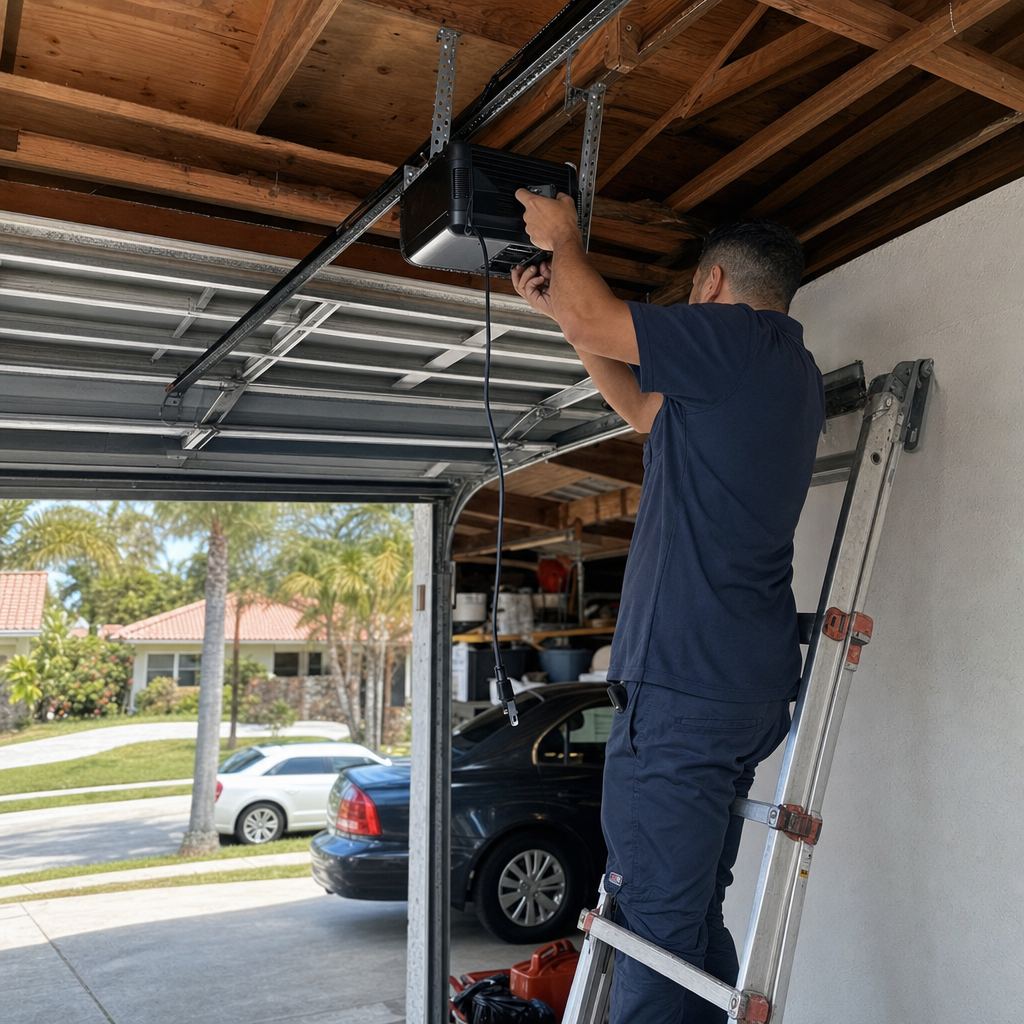
- Opener compatibility upgrade ($180–$450): Miami-Dade’s wind-rated doors are heavier than standard doors. A 1/2 HP opener that ran your old door might not handle the new one reliably. LiftMaster and Chamberlain both make 3/4 HP and belt-drive models sized for heavier doors — budget for this if your opener is more than 8 years old.
- Haul-away and disposal ($50–$120): Your old door panels, hardware, and tracks have to go somewhere. Not all installers include removal in their base price. Ask before you sign.
- Framing repair ($150–$400+): Homes in neighborhoods like Little Havana, Overtown, and Allapattah sometimes have garages built in the 1950s–70s with wood framing that’s absorbed decades of South Florida humidity. If the rough opening needs work before the new door can be properly anchored, that’s a separate line item.
- Keypad, remote, or smart-home integration ($35–$150): A new Genie or LiftMaster opener is a fresh system — your existing remotes may not pair, or you may want to add a wall keypad or MyQ connectivity. Minor cost, but it adds up if you didn’t account for it.
Repair vs. Replace: How to Decide in Miami’s Market
Not every garage door problem in Miami is a replacement job, and a contractor who quotes replacement before exploring repair isn’t serving you well. Here’s a practical framework:
- If the door is under 10 years old and structurally sound: Repair almost always wins on cost. A broken spring, snapped cable, bent panel, or failed opener are all serviceable. Most Miami repair calls — springs, cables, rollers, openers — run $180–$480 and are same-day fixes.
- If the door is 15+ years old and not wind-rated: Replacement is worth serious consideration, especially if you’re approaching a hurricane season. An older door that doesn’t carry current Miami-Dade wind-load approval is a liability, not just an inconvenience. Insurance carriers are paying attention.
- If the door has sustained hurricane or impact damage: Have the structural integrity — not just the cosmetics — assessed before deciding. A dented panel on a sound door is repairable; a door where the reinforcement struts are bent or the bottom seal is compromised is a different conversation.
- If the door has multiple failing components: When a door needs springs, cables, rollers, and a panel, the repair estimate sometimes approaches 60–70% of a new door’s cost. At that point, replacement gives you a warranty, a new Miami-Dade-rated system, and a door that starts a fresh service clock.
- If it’s purely cosmetic: Faded paint, minor dents, and worn weatherstripping don’t require replacement. These are maintenance items, and addressing them extends the life of an otherwise functional door.
Our Professional Garage Door Repair Miami Team home covers the full repair scope in detail — it’s worth a read before you commit to either path.
How to Evaluate a Quote
A legitimate garage door replacement quote in the Miami market should be itemized. Here’s what a complete, trustworthy estimate includes — and the red flags that suggest a contractor is either cutting corners or planning to add costs after you’ve signed:
What a Solid Quote Includes
- Door brand, model, and specific wind-load rating — not just “hurricane-rated steel door.” Ask for the NOA number or Florida Product Approval number. Clopay, Amarr, and Wayne Dalton all publish these on their specification sheets.
- Labor cost, broken out separately from materials — so you can compare apples to apples across multiple bids.
- Permit fee, or a clear statement that the contractor handles permitting — if permits aren’t mentioned, ask directly.
- Spring replacement or inspection line item — a good installer assesses your existing hardware and tells you the condition, then prices accordingly.
- Haul-away and disposal of the old door.
- Opener assessment — will your existing opener work with the new door? What’s the cost if it won’t?
- Warranty terms on both the door and the installation labor — manufacturer warranties on Clopay, Amarr, and Wayne Dalton panels vary by product line. Labor warranties should be stated in writing.
Red Flags in a Quote
- A single flat number with no line items.
- No mention of permits or NOA documentation.
- A price that’s 30–40% below other bids without explanation — the door is either non-rated, the permit is being skipped, or the labor is being cut.
- Pressure to sign same-day to “lock in pricing” — a legitimate contractor’s pricing doesn’t expire overnight.
- No written warranty on labor.
Rated 4.9 stars across 543 reviews, Jacob Nguyen’s approach has always been a fully itemized written estimate before any work begins — if you want to see what that looks like in practice, call (904) 552-6124 for a free estimate.
Common Mistakes to Avoid
- Buying a non-wind-rated door to save money upfront. In Miami-Dade, this door won’t pass inspection and may not be insurable. The savings evaporate the first time you need to file a claim or sell the house.
- Accepting a quote with no permit line item. An unpermitted replacement can trigger fines from Miami-Dade code enforcement, complicate your homeowner’s insurance, and create a disclosure obligation at resale. The $225–$500 permit cost is not worth avoiding.
- Replacing the door without assessing the opener. A new hurricane-rated door on an underpowered opener is a service call waiting to happen — especially in Doral or Kendall where homes often have larger two-car openings that put real strain on a 1/2 HP motor.
- Ignoring spring replacement at installation time. If your springs are at or near their rated cycle life (typically 10,000 cycles for standard springs), replacing them now costs about $120–$280. Replacing them on an emergency call six months later costs the same — plus a service trip fee and the inconvenience of a door that won’t move.
- Hiring a general handyman for hurricane-rated installation. The Miami-Dade inspection process requires the installer to certify that the door was installed per the manufacturer’s approved instructions for the specific NOA. A handyman without that documentation creates a real permitting problem.
- Choosing a contractor based on price alone without checking reviews. A low bid from a contractor with no verifiable review history in Miami is a risk that doesn’t price itself into the quote. Check Google, verify reviews look real, and look for a pattern of specific job-level feedback — not a handful of generic five-star entries.
- Assuming a door that “looks fine” after a storm is undamaged. Hurricanes and tropical storms generate pressure differentials that can compromise reinforcement struts and seals without visibly denting the panels. If you experienced sustained winds above 60 mph, have the door physically inspected — not just eyeballed from the driveway.
When to Call a Professional
Call a professional immediately if your door won’t close and the garage is accessible from the outside — that’s a security exposure, not just a mechanical inconvenience. Call before hurricane season if your door is more than 12 years old and you don’t have documentation of its wind-load rating; a door failure during a storm puts the entire structure at risk. Call if you hear a loud bang from the garage — that’s almost always a broken spring, and springs under tension are genuinely dangerous to handle without the right tools and training. And call if your door is partially open and won’t move in either direction, which typically means a cable has snapped and is now binding in the track.
Professional Garage Door Repair Miami Team offers free estimates in Miami — call (904) 552-6124 and Jacob will give you a straight answer on whether you’re looking at a repair, a replacement, or just a tune-up.
Frequently Asked Questions
How much does a garage door replacement cost in Miami in 2026?
A code-compliant garage door replacement in Miami runs $1,400–$3,800 installed for most residential jobs, including a wind-rated door, labor, and permit. The lower end of that range covers a single-car steel door with standard insulation; the upper end reflects double-car aluminum full-view doors or high-end wood composite with premium hardware. National averages you’ll find online typically exclude the wind-rated door premium and permit costs that are mandatory in Miami-Dade — which is why those numbers look so much lower. Call (904) 552-6124 for a free itemized estimate specific to your door size and opening.
Is a permit required for garage door replacement in Miami?
Yes — a permit is required under the Florida Building Code for any full garage door replacement in Miami-Dade County. The permit confirms that the installed door carries a current Notice of Acceptance (NOA) for Miami-Dade’s wind-load zone and that it was installed per approved specifications. Skipping the permit to save $225–$500 creates insurance, resale, and code enforcement risk that significantly outweighs the short-term savings. Any contractor who discourages you from pulling a permit should be a disqualifying red flag.
How long do garage door springs last in Miami’s climate?
Standard torsion springs are rated for approximately 10,000 open/close cycles — at two uses per day, that’s roughly 13–14 years. In Miami, salt air and humidity accelerate metal fatigue, so springs near the coast (Miami Beach, Key Biscayne, South Beach) often show wear earlier. We regularly see springs in Coconut Grove and Pinecrest develop stress corrosion in the 8–10 year range. If your springs are original to a door installed before 2015, a proactive replacement during your next service call is worth the $120–$280 — it’s far less disruptive than an emergency failure. Call (904) 552-6124 for an honest assessment.
Can I install a garage door myself in Miami to save money?
Technically, a homeowner can pull an owner-builder permit in Miami-Dade, but the practical barriers are significant. The door must still carry a valid NOA, the installation must follow the manufacturer’s Miami-Dade-approved installation instructions exactly, and a licensed inspector will verify compliance. Garage door spring installation specifically carries serious injury risk — torsion springs store energy equivalent to hundreds of foot-pounds of torque. Most homeowners who price out DIY find that the permit process, specialized tools, and liability exposure make professional installation the more sensible path within about an hour of research.
What’s the difference between a Clopay and an Amarr garage door for a Miami home?
Both Clopay and Amarr manufacture doors with Miami-Dade Notice of Acceptance across multiple product lines — either is a legitimate choice for a compliant installation. Clopay’s wind-code lines (including the Canyon Ridge and Coachman series) tend to offer more design variety at the mid-to-upper price range. Amarr’s Hillcrest and Heritage lines are strong mid-range options with solid warranty terms. The meaningful selection criterion in Miami is the specific NOA number for your wind zone and opening size — not just the brand name. Jacob has worked with both extensively and can match the right product to your home’s requirements and your budget.
How do I know if my garage door opener is compatible with a new wind-rated door?
The key factor is the door’s weight — hurricane-rated doors, particularly insulated steel and aluminum full-view models, are meaningfully heavier than standard residential doors. A 1/2 HP chain-drive opener that handled your old door may struggle with a heavier wind-rated replacement, shortening the motor’s lifespan and causing strain under daily use. LiftMaster’s 8500W series and Chamberlain’s belt-drive 3/4 HP models are well-suited to the heavier doors common in Miami installations. During any replacement estimate, the opener should be assessed as part of the quote — not treated as a separate afterthought. For Garage Door Opener in Hialeah needs specifically, that page covers the full opener selection and service scope.
The Bottom Line
Miami garage door costs are higher than national guides suggest — and for legitimate reasons. Hurricane-rated construction, mandatory permitting, and a labor market with real accountability differences add up to a total that looks different from what you’ll find on a generic cost calculator. The useful number isn’t the lowest quote you can find; it’s the fully itemized price for a code-compliant installation that will hold through a storm, pass inspection, and come with a real warranty. Get at least two written, itemized estimates. Verify the NOA documentation. Ask directly about permits. And if you want a straight answer on what your specific door and opening will cost in Miami’s 2026 market, call (904) 552-6124 — Jacob Nguyen will tell you exactly what you’re looking at, in writing, before any work begins. Estimates are free.
For homeowners in the northern part of the metro, the Garage Door Repair in Hialeah and Garage Door Installation in Hialeah pages cover local pricing and service details specific to that market.
Written by Jacob Nguyen, Owner & Lead Technician at Professional Garage Door Repair Miami Team, serving Miami since 2021.