Last updated June 28, 2026
Garage Door Permits, Codes & Inspections in FL: What You Need to Know
Most homeowners in Miami assume a garage door swap is a straightforward Saturday project — buy the door, hire someone to install it, done. What they don’t realize is that Florida has some of the toughest garage door code requirements in the country, and skipping the permit process isn’t just a bureaucratic oversight. We’ve seen it firsthand: an unpermitted garage door replacement in Miami-Dade can legally stall a home sale, trigger a retroactive inspection that costs several times the original permit fee, and in some cases void homeowner’s insurance coverage for storm damage. This guide covers exactly what permits apply, which projects trigger them, what inspectors look for, and how to protect yourself before you list your home.
Quick Answer
In Florida, any garage door replacement — not just new installation — generally requires a building permit in Miami-Dade and Broward County because the door must meet specific wind-load requirements under the Florida Building Code. The door must carry a valid Miami-Dade Notice of Acceptance (NOA) or Florida Product Approval number, and a licensed contractor must pull the permit before work begins. Skipping this step can void storm-related insurance claims and create an unpermitted-work disclosure problem at closing.
Table of Contents
- Which Garage Door Projects Require a Permit in Florida?
- Miami-Dade vs. Broward County: How the Thresholds Differ
- Miami-Dade NOA and Florida Product Approval: What They Mean and How to Check
- Florida Building Code Wind Load Requirements by Zone
- What Happens During a Garage Door Inspection
- How to Handle a Previously Unpermitted Garage Door Before You Sell
- Common Mistakes to Avoid
- When to Call a Professional
- Frequently Asked Questions
- The Bottom Line
Which Garage Door Projects Require a Permit in Florida?
Florida’s permitting rules catch a lot of homeowners off guard because the threshold isn’t tied to project cost — it’s tied to structural change. Under the Florida Building Code (FBC), a garage door is classified as a component of the building envelope, which means it directly affects the structure’s ability to resist wind pressure. That classification has real consequences for what triggers a permit.
Projects that require a permit in Florida:
- Full garage door replacement — swapping out an existing door for a new one, regardless of whether the rough opening changes.
- New garage door installation — installing a door in a previously open or differently configured opening.
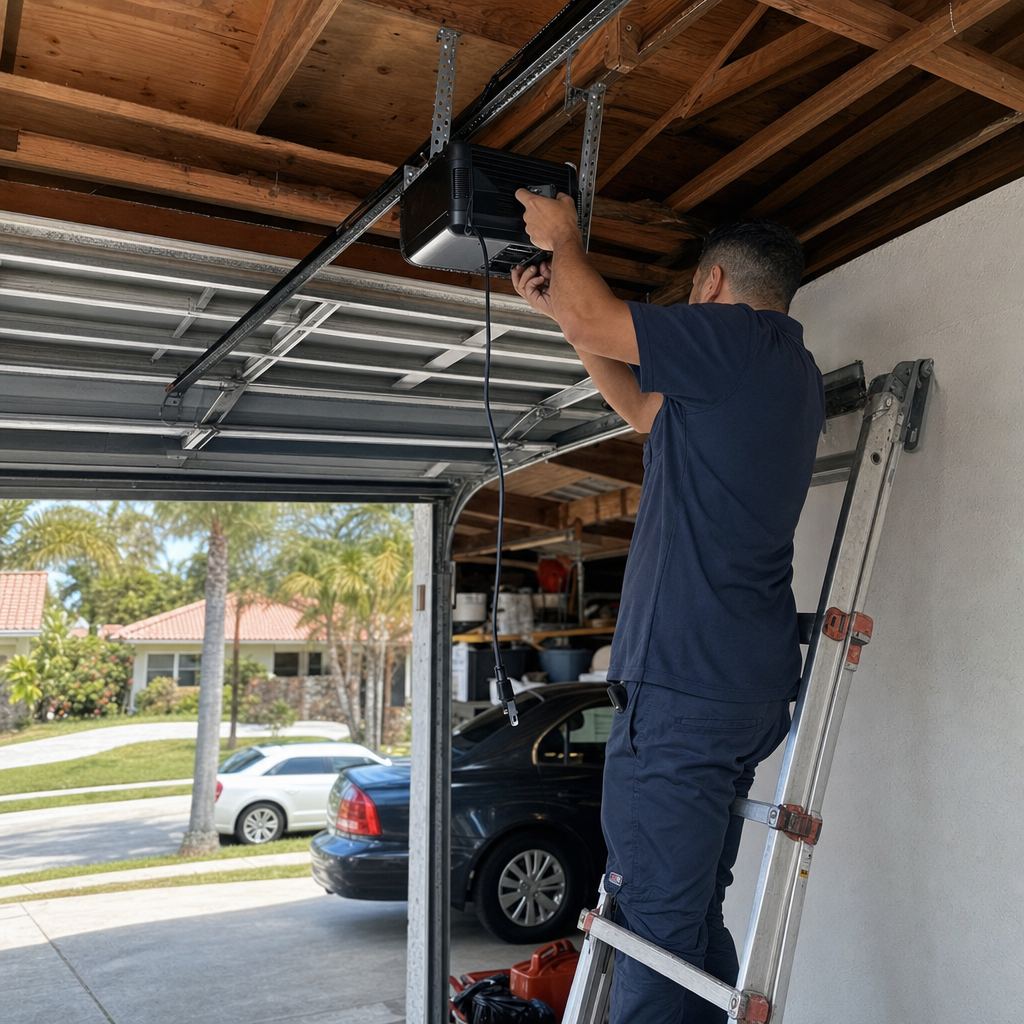
- Garage door opener installation on a replaced door — if the opener is being installed as part of a permitted door job, it’s typically covered under the same permit.
- Panel replacement that affects the structural integrity or wind-resistance rating — replacing multiple panels or a full section may require a permit depending on county interpretation.
- Adding hurricane bracing or wind-load reinforcement hardware to an existing door.
Projects that typically do NOT require a permit:
- Spring replacement (torsion or extension) on an existing permitted door.
- Cable replacement on an existing door.
- Opener repair or like-for-like opener replacement on an existing permitted door.
- Roller, hinge, or track adjustment on an existing door.
When in doubt, call Miami-Dade’s Building Department directly or ask your contractor to confirm before work begins. The cost of a permit is almost always less than the cost of retroactively resolving unpermitted work.
Miami-Dade vs. Broward County: How the Thresholds Differ
One of the most widely misquoted topics in online garage door guides is this: Miami-Dade and Broward County do not operate under identical permitting rules, even though both fall under the Florida Building Code umbrella. The distinction matters if you own property near the county line or if you’re comparing quotes from contractors who work across both counties.
Miami-Dade County operates under one of the strictest local amendments to the FBC in the state. Because the county sits in a High-Velocity Hurricane Zone (HVHZ), every garage door replacement requires a building permit — no dollar-value exemption applies to doors here. The door must carry a valid Miami-Dade Notice of Acceptance (NOA), not just a state-level Florida Product Approval. Miami-Dade’s Building and Neighborhood Compliance Department enforces this actively, and inspectors in areas like Coral Gables, Kendall, and Hialeah routinely flag garage doors installed without visible NOA documentation.
Broward County also falls within the HVHZ designation and generally requires permits for full door replacements. However, Broward municipalities vary slightly in their enforcement. Some cities — like Hollywood and Pompano Beach — have adopted stricter local amendments, while others default more cleanly to the state-level FBC with Florida Product Approval (rather than specifically requiring Miami-Dade NOA). If your property is in an unincorporated part of Broward, the county building department is your point of contact.
The practical bottom line: if you’re replacing a garage door anywhere in South Florida, assume a permit is required. The consequences of assuming otherwise are far more expensive than the permit itself.
Miami-Dade NOA and Florida Product Approval: What They Mean and How to Check
This is the part of the Florida garage door code that surprises even experienced homeowners. Florida requires that building products — including garage doors — be tested and approved for wind resistance before they can be legally installed. In Miami-Dade’s HVHZ, that approval takes the form of a Notice of Acceptance (NOA), issued by the Miami-Dade County Product Control Division. Statewide, the equivalent is a Florida Product Approval (FPA) number issued through the Florida Department of Business and Professional Regulation (DBPR).
What these approvals actually confirm:
- The door has been independently tested to withstand specific wind speeds and pressures.
- The installation method described in the approval document was part of the test — meaning the hardware, fasteners, and track system matter, not just the door panels.
- The door meets the design pressure (DP) rating required for its wind zone and opening size.
How to find a door’s NOA number:
- Ask your contractor or supplier for the NOA or FPA number before the door is ordered. Reputable manufacturers — including Clopay, Amarr, Wayne Dalton, and Raynor — list these numbers in their product specs.
- Search the Miami-Dade Product Control database at miamidade.gov/building/pc-search.asp using the manufacturer name and product category.
- For statewide FPA, search the Florida Building Commission’s product approval database at floridabuilding.org/pr.
- Once confirmed, keep a copy of the NOA document — inspectors may ask to see it at the time of inspection.
In our five years working across Miami, we’ve seen inspectors in Hialeah and Doral reject installations where the correct door was used but the track system didn’t match the NOA’s specified hardware. The approval covers the entire system, not just the panel.
Florida Building Code Wind Load Requirements by Zone
Florida is divided into wind zones under the FBC, and the design pressure your garage door must meet is determined by your specific location — not just the county you’re in. Miami falls squarely in the High-Velocity Hurricane Zone (HVHZ), which carries the highest requirements in the state.
Key wind-load concepts every homeowner should understand:
- Design Pressure (DP) Rating: Measures the door’s resistance to both positive pressure (wind pushing in) and negative pressure (wind pulling out). A door rated DP +40/-60 can withstand 40 PSF of inward pressure and 60 PSF of outward suction.
- Wind Speed Map: ASCE 7 wind maps divide Florida into risk categories. Most of Miami-Dade sits in the 170 mph (Risk Category II) zone — one of the highest in the continental U.S.
- Opening Size Multiplier: Larger openings require higher DP ratings for the same wind speed. A standard 16-foot wide door needs a higher DP rating than a 9-foot door at the same address.
How to confirm your door meets the standard for your address:
- Use the Florida Wind Speed lookup tool at floridabuilding.org/fbc/committees/structural/wind_speed to find your design wind speed by address.
- Cross-reference that speed with ASCE 7 pressure tables to get the minimum DP rating for your opening size.
- Confirm the door you’re purchasing has an NOA or FPA that lists the required DP rating at or above your calculated minimum.
- Verify that the NOA covers the exact opening width and height you have — approvals are size-specific.
Brands like Clopay and Wayne Dalton publish wind-resistance spec sheets by product line that make this cross-referencing straightforward. If a contractor can’t tell you the DP rating of the door they’re proposing for your Miami home, that’s a red flag worth acting on.
What Happens During a Garage Door Inspection
A lot of homeowners treat the inspection as a formality — it isn’t. Miami-Dade inspectors are specifically trained on HVHZ requirements, and garage door inspections are among the more detailed residential inspections because the door is a critical wind-load component. Here’s what an inspector actually looks at:
What inspectors verify:
- NOA or FPA documentation — The inspector wants to see the approval number and confirm it matches the door installed. If the contractor didn’t leave a copy on site, that alone can trigger a failed inspection.
- Track and hardware configuration — Does the installed track system match what the NOA specifies? Substituting a different track gauge or bracket style voids the approval.
- Fastener type and spacing — The NOA installation instructions specify exact fastener sizes, counts, and spacing into the jamb framing. Inspectors probe these closely, especially in older Miami homes with wood-framed garages in areas like Coconut Grove or Little Havana where wood deterioration is common.
- Bottom seal and astragal — The door must contact the floor properly across its full width.
- Permit card or e-permit posting — A copy of the permit must be posted at the job site or accessible digitally.
- Opener installation compliance — If an opener was installed as part of the permit, the inspector checks that it’s compatible with the door’s DP rating and that the emergency release is functional.
Common reasons for a failed inspection:
- Wrong track system for the approved door model.
- Missing or incomplete NOA paperwork on site.
- Fasteners installed into deteriorated or insufficient framing without remediation.
- Door bottom not making full contact with the floor slab.
- Opener installed without a UL-listed entrapment protection device.
A failed inspection means a reinspection fee and a delay in closing the permit — which in turn delays any sale or refinancing that depends on clean permit history.
How to Handle a Previously Unpermitted Garage Door Before You Sell
This is the scenario we see most often in Miami when homeowners are preparing to list: a garage door was replaced two or three years ago by a handyman or an out-of-county contractor, no permit was pulled, and now the title search or home inspection is flagging it. Here’s the straightforward path through it.
Step 1: Don’t panic — but don’t ignore it. Unpermitted work in Miami-Dade doesn’t automatically disqualify a sale, but it does require resolution. Disclosing it and leaving it unresolved puts the burden of remedy on the buyer, which often kills deals or reduces the sale price more than the fix would have cost.
Step 2: Hire a licensed contractor to assess the existing installation. The door may already meet current code — you just don’t have the paperwork to prove it. A licensed contractor can inspect the door, confirm its NOA or FPA number, and determine whether the installation matches the approval’s requirements.
Step 3: Pull an “after-the-fact” permit. Miami-Dade allows retroactive permits, sometimes called permit-after-construction or after-the-fact permits. Expect to pay the standard permit fee plus a surcharge — often 2x to 4x the original permit cost — and to schedule an inspection.
Step 4: If the installation doesn’t pass inspection, the door must be brought into compliance. This may mean adjusting the track system, replacing fasteners, or in some cases replacing the door itself if it lacks a valid NOA. This is why the original permit matters: a door sold without verifying NOA compliance may not be correctable without full replacement.
If you’re in this situation in Miami, our team at Professional Garage Door Repair Miami Team home can assess your existing door, pull the permit paperwork, and shepherd the project through inspection — one call, fully handled.
Common Mistakes to Avoid
- Hiring a contractor who says “we don’t pull permits here.” In Miami-Dade’s HVHZ, that contractor is either unfamiliar with local code or deliberately cutting corners. Either way, you’re the one who inherits the liability when the work is done on your property.
- Assuming the door you bought at a big-box store has an NOA. Some doors sold nationally carry only a Florida Product Approval, not a Miami-Dade NOA. For HVHZ properties, you need the NOA — confirm before purchase, not after installation.
- Letting the opener install happen under a separate “handyman” agreement. If the opener is installed as part of a permitted door replacement, it must be included in the permit scope. A separate unlicensed opener install on a newly permitted door can trigger a compliance issue at final inspection.
- Not keeping a copy of the NOA documentation after the project closes. Miami homeowners in high-turnover neighborhoods like Doral and Brickell have lost NOA paperwork and then struggled to prove code compliance during a sale years later. Store a digital copy with your closing documents.
- Treating a panel replacement as a “repair” to avoid permitting. Replacing three or more panels on a sectional door can change the door’s structural behavior and may trigger permit requirements in Miami-Dade. When in doubt, call the building department first.
- Choosing a door based on price alone without checking the DP rating for your address. A door with a DP rating adequate for Orlando is not necessarily adequate for a property in Miami near Biscayne Bay, where wind exposure is higher.
- Waiting until you’re under contract to sell before addressing unpermitted work. Retroactive permits take time — sometimes several weeks for inspections to be scheduled. Starting this process under the pressure of a 30-day closing window is an avoidable headache.
When to Call a Professional
Any garage door project in Miami that involves a full replacement, new installation, or wind-resistance upgrade should be handled by a licensed contractor who is actively familiar with Miami-Dade NOA requirements — not just someone who does occasional door work between other trades. Specifically, call a professional when:
- You’re replacing a door and aren’t certain the new door carries a valid Miami-Dade NOA for your opening size.
- Your property is in a coastal or bay-adjacent area with elevated wind exposure requirements.
- You’re preparing to sell and need an assessment of your existing door’s permit status.
- A previous installation failed inspection and you need a licensed contractor to correct and reinspect.
- You need an after-the-fact permit pulled on work that was done without one.
Professional Garage Door Repair Miami Team offers free estimates in Miami — Jacob Nguyen handles assessments personally, which means you’re talking to the person who will actually do the work, not a scheduler routing you to whoever’s available. Call (904) 552-6124 to get an honest read on where your door stands.
If you’re in Hialeah, our Garage Door Repair in Hialeah page covers local service details, and we handle permitting for those projects the same way we do in Miami proper.
Frequently Asked Questions
Does replacing a garage door in Florida always require a permit?
In Miami-Dade County, yes — a permit is required for any full garage door replacement because the county sits in a High-Velocity Hurricane Zone where every door replacement is treated as a structural change to the building envelope. Broward County follows similar rules under the same HVHZ designation. The only projects that typically don’t require permits are repairs to an existing permitted door’s mechanical components (springs, cables, rollers). If you’re unsure, call Miami-Dade’s Building Department before work starts — it’s a free call that can save a very expensive problem later.
What is a Miami-Dade NOA and do I need one for my garage door?
A Notice of Acceptance (NOA) is Miami-Dade County’s product-level certification that a garage door — and its complete installation system — has been independently tested to meet HVHZ wind-load requirements. If your property is in Miami-Dade, your replacement door must carry a valid NOA, not just a state-level Florida Product Approval. You can verify an NOA by searching the Miami-Dade Product Control database online using the manufacturer name. Doors from manufacturers like Clopay, Amarr, and Wayne Dalton publish their NOA numbers in product literature — ask for it before you order.
How much does a garage door permit typically cost in Miami-Dade?
Permit fees in Miami-Dade for a residential garage door replacement generally range from $100 to $300, depending on the project value and specific municipality within the county. Cities like Hialeah and Coral Gables have their own building departments and fee schedules, which can vary slightly from Miami proper. After-the-fact (retroactive) permits typically carry a surcharge of two to four times the standard fee on top of the base cost. For a current fee estimate specific to your address, the Miami-Dade Building Department’s online permit fee calculator is the most reliable source. Call (904) 552-6124 and we can walk you through what to expect for your project.
Can an unpermitted garage door installation prevent me from selling my home in Miami?
Yes — it can delay or derail a closing. Unpermitted work in Miami-Dade must be disclosed to buyers, and most lenders financing a purchase will require that open permit issues be resolved before funding. The path through it is an after-the-fact permit, a licensed inspection, and if necessary, corrections to bring the installation into compliance. Starting this process early — before you’re under contract — gives you time to resolve it without the pressure of a closing deadline. We handle after-the-fact permit work regularly for Miami homeowners who inherited unpermitted installations from previous owners or past contractors.
What wind load rating does my garage door need in Miami?
Most residential properties in Miami-Dade require a door rated for design wind speeds of 170 mph (Risk Category II under ASCE 7), though specific design pressure (DP) requirements depend on your exact address, the door’s width and height, and the building’s exposure category. A standard 16-foot wide door in a coastal or open-exposure Miami neighborhood will require a higher DP rating than the same door in a sheltered inland location. The Florida Building Commission’s wind speed lookup tool at floridabuilding.org lets you enter your address for a confirmed figure. Your contractor should be doing this calculation before specifying a door — if they’re not, ask explicitly.
Does a garage door opener installation require a separate permit in Florida?
A standalone like-for-like opener replacement on an existing, properly permitted door generally does not require a separate permit in Miami-Dade, provided the opener is compatible with the door’s DP rating and includes required safety features (UL-listed entrapment protection). However, if the opener is being installed as part of a new door installation that’s under permit, it must be included in the permit scope — you can’t split the project to avoid inspection. For our Garage Door Opener in Hialeah customers, we confirm permit requirements during the estimate phase so there are no surprises at inspection. Call (904) 552-6124 if you’re unsure whether your opener project needs a permit.
The Bottom Line
Florida’s garage door permit and code requirements exist for one reason: a door that fails in a hurricane isn’t just a property loss — it can depressurize the entire structure and cause catastrophic damage. Miami-Dade’s HVHZ rules are strict because the consequences of non-compliance are real and local. The key points to take away from this guide: full replacements require permits in Miami-Dade and Broward; your door must carry a valid NOA for HVHZ properties; the inspection covers the entire installed system, not just the panel; and unpermitted work can create genuine legal and financial problems at closing. Handle it right the first time, and the permit process is straightforward. Handle it wrong, and it gets expensive fast.
If you’re planning a garage door replacement in Miami, or you need an honest assessment of an existing installation’s permit status, Jacob Nguyen is available for a free on-site estimate. With 543 verified reviews averaging 4.9 stars and five years of focused work across Miami, the assessment comes with real experience behind it. For Garage Door Installation in Hialeah and surrounding areas, we apply the same Miami-Dade code knowledge to every project. Call (904) 552-6124 — Jacob handles it personally.
Written by Jacob Nguyen, Owner & Lead Technician at Professional Garage Door Repair Miami Team, serving Miami since 2021.